Are modern dairy cows resilient enough to live as long (and as healthily) as we would like them to?
ArticlePosted: January 14, 2026
By Nial O’Boyle, Product Director at CattleEye
Lameness continues to be a significant economic and welfare burden on the dairy industry. Progress in management, cow comfort and monitoring has helped and continues to help, but there is an ethical tension the industry does not often articulate clearly.
As an industry we are increasingly asking cows to live longer. Longevity helps with lower replacement rate costs, reduced emissions intensity, and improved lifetime efficiency. However, lifespan and health span do not always align.
Age has long been recognised as a risk factor for lameness. The question now is whether the industry’s drive for longevity is sufficiently aligned with the cow’s capacity to remain comfortable and mobile as she ages, or whether lifespan is being extended faster than health span can support.
Using CattleEye mobility data from 25 commercial dairy herds, covering just over 41,000 cows, we examined how the risk of impaired mobility changes as cows move through successive lactations (see table below). For each herd, we calculated the proportion of cows with a mobility score of 65 or higher in first, second, third, fourth and fifth-plus lactation.
CattleEye provides a score from 1 to 100, with quartile-based thresholds broadly aligning with the UK Register of Mobility Scorers (RoMS) scale. A mobility threshold of ≥65 was used, corresponding approximately to cows that would be classified at the top end of RoMS score 2 or higher, indicating impaired or severely impaired mobility.
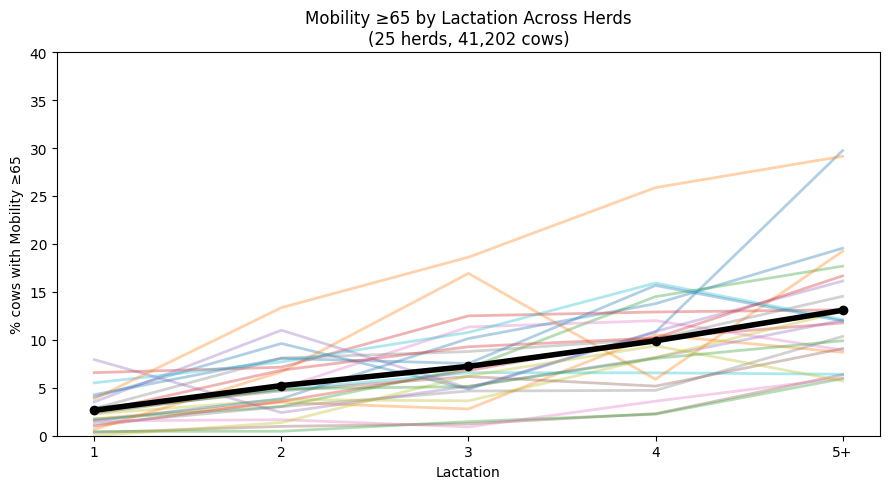
Each herd contributed equally to the analysis, regardless of size. The aim was to examine lameness prevalence changes across lactations.
There is a clear pattern of higher prevalence as lactations progress. Around 2.7% of first-lactation cows show impaired mobility. This rises to just over 5% in second lactation, 7% in third, close to 10% in fourth, and over 13% in cows that make it to fifth lactation and beyond.
What stands out here is how steadily that risk accumulates, across different farms, management styles and locations. This raises important questions for the wider industry.
We want cows to live longer, for sound economic and environmental reasons. But living longer only makes sense if cows remain comfortable and mobile. The question is not whether longer lifespans are desirable, but whether modern breeding has placed enough emphasis on resilience alongside production.
Work in this area is progressing. In the UK, the University of Liverpool and AHDB have developed the Lameness Advantage genetic index. In the United States, research from the Council on Dairy Cattle Breeding and the University of Minnesota has confirmed that lameness is meaningfully heritable. Early analyses using CattleEye mobility data suggest heritability estimates in the region of 10–30% for mobility traits. This has the potential to be very impactful, implying that selection decisions made today can influence mobility outcomes years down the line.
One of the strengths of systems like CattleEye is the ability to collect frequent, objective measurements at scale. This shifts mobility from being an occasional, subjective judgement to a measurable biological trait. This is important for the industry to breed cows that are not just productive, but robust over a longer working life. Looking beyond simple prevalence figures also reveals another layer of complexity. In a follow-up analysis of one 700-cow herd, we examined what happened after cows experienced an initial episode of impaired mobility. The likelihood of relapse rose sharply with advancing lactation. Just over half of first-lactation cows relapsed after their first mobility issue. For cows first affected in fourth lactation or later, relapse rates exceeded 90%.
This pattern is not readily captured by point-in-time prevalence metrics, which again may underestimate cumulative welfare burden in herds with different age profiles. Tools like CattleEye have the potential to support the development of more resilient cows that can live healthier for longer.
To find out more about CattleEye and to talk to one of our experts, please reach out via contact@cattleeye.com